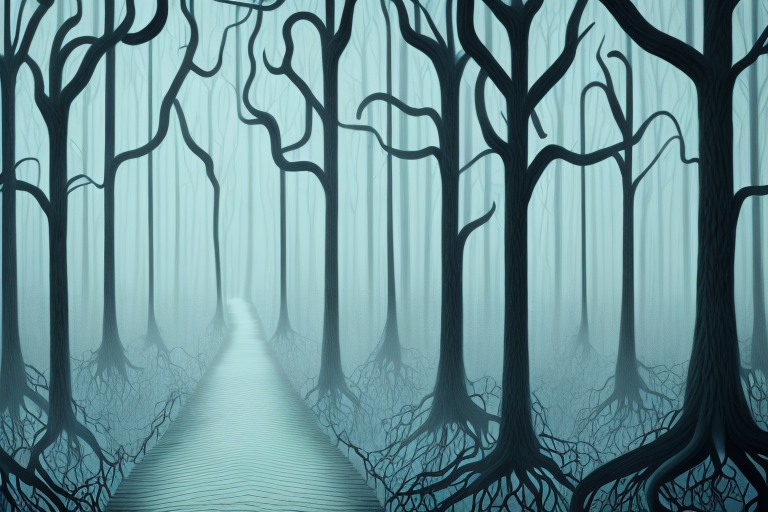
If you’re a fan of the thriller genre, you’ve likely come across Ruth Ware’s In a Dark, Dark Wood and Lars Emmerich’s Mindscrew. Both novels have captivated audiences with their twists, turns and suspenseful themes. In this article, we’ll delve deeper into the similarities and differences between the two books by analyzing their authors, themes, narrative structure, character development, use of setting, and plot twists. By the end of this article, you’ll gain a thorough understanding of these two works, and be better equipped to choose which one to read, or perhaps to appreciate each anew. So, let’s begin.
A closer look at the authors behind In a Dark, Dark Wood and Mindscrew
It’s important to understand the backgrounds of the authors who penned these novels, as their experiences and interests likely shaped the stories they told. Ruth Ware is a British author who has written several hit thrillers, including The Woman in Cabin 10 and The Turn of the Key. She began her writing career as a journalist for various newspapers and magazines, which may have honed her ability to capture suspenseful and engaging stories that grip readers from start to finish.
Lars Emmerich, on the other hand, is an American author and screenwriter who has written numerous novels, including Lies That Bind Us and The Tesla Secret. He has also written and produced films and television shows for companies like HBO and Warner Bros. His experience in writing for the screen may be evident in his approach to storytelling, which often involves quick pacing, sharp dialogue and vivid imagery.
Despite their different backgrounds, both Ware and Emmerich share a love for mystery and suspense. Ware has cited Agatha Christie as one of her biggest influences, while Emmerich has mentioned Alfred Hitchcock as a source of inspiration. This love for the genre is evident in their writing, as both authors have created complex and intriguing plots that keep readers guessing until the very end.
Another interesting aspect of their writing is their use of setting. Ware’s novels often take place in isolated or claustrophobic environments, such as a cruise ship or a remote cabin in the woods. Emmerich, on the other hand, has set his stories in a variety of locations, from the streets of New York City to the deserts of the Middle East. This attention to detail in setting adds an extra layer of depth to their stories, making them feel more immersive and realistic.
Themes of isolation and survival in In a Dark, Dark Wood
In a Dark, Dark Wood is set in a remote location in the English countryside, where the protagonist, a crime writer named Leonora Shaw, attends a hen party with a group of old friends. The novel explores themes of isolation and survival as the group becomes stranded and their lives are threatened by an unknown assailant. The fear and helplessness that the characters experience as they struggle to survive creates a sense of tension and suspense throughout the book.
One of the ways in which the theme of isolation is explored in the novel is through the setting. The remote location of the hen party means that the characters are cut off from the outside world, with no means of communication or escape. This sense of isolation is heightened by the fact that the group is made up of old friends who have grown apart over the years, and who are now forced to confront their differences and past grievances in the face of a common threat.
The theme of survival is also closely linked to the idea of isolation, as the characters must rely on their own resources and ingenuity to stay alive. Throughout the novel, we see the characters adapting to their situation, using whatever tools and knowledge they have to try and outwit their attacker. This emphasis on survival creates a sense of urgency and immediacy in the narrative, as we are constantly reminded of the characters’ vulnerability and the high stakes of their situation.
Mindscrew’s exploration of psychological manipulation and control
By contrast, Mindscrew is set in modern-day New York City, and centers around a young man named Richard who becomes embroiled in a high-stakes game of psychological manipulation and control. Themes of power, greed and deceit permeate the novel as Richard is forced to navigate a dangerous web of lies and deceit in order to survive. The mind games that play out between the characters create a tense atmosphere that keeps readers on edge until the very end.
A comparison of narrative structure in the two novels
While both novels are thrillers with suspenseful plots, they differ in their approach to narrative structure. In a Dark, Dark Wood is told in first-person perspective, with Leonora as the narrator. This allows readers to see the events of the story through her eyes and experience the fear and anxiety that she feels as things spiral out of control. Mindscrew, on the other hand, is told in third-person omniscient perspective, which allows readers to see into the minds and motives of multiple characters. This approach creates a more complex and layered narrative that keeps readers guessing until the very end.
The role of suspense and tension in both books
Suspense and tension are key elements in both novels, but they are achieved in different ways. In a Dark, Dark Wood uses setting and atmosphere to create a sense of isolation and dread, as the characters become increasingly cut off from the outside world. Mindscrew, on the other hand, uses dialogue and character interactions to create a sense of unease and mistrust, as readers are never quite sure who to trust. Both novels are successful in creating a high-stakes atmosphere that keeps readers glued to the page.
A study of character development in In a Dark, Dark Wood and Mindscrew
Both novels feature complex and well-developed characters who are forced to confront their own fears and flaws as they struggle to survive. In a Dark, Dark Wood explores the psychological damage that isolation and trauma can inflict on a person, as Leonora is forced to confront dark secrets from her past. Mindscrew, by contrast, focuses on the vulnerabilities and flaws of its characters, and highlights how these weaknesses can be exploited by others for personal gain.
The use of setting to create atmosphere in the two novels
As mentioned earlier, In a Dark, Dark Wood is set in a remote location in the English countryside, which serves to heighten the sense of isolation and danger that the characters face. The novel is successful in using the setting to create a sense of claustrophobia and unease, as the characters become increasingly cut off from the outside world. In Mindscrew, the setting is modern-day New York City, which is depicted as a busy and chaotic place where danger can lurk around every corner. The city serves as a perfect backdrop for the story’s themes of power, greed and manipulation.
The impact of plot twists on reader engagement
Both novels feature surprising plot twists that keep readers engaged and guessing until the very end. In a Dark, Dark Wood’s plot twist involves a shocking revelation about one of the characters that turns everything that has come before upside down. Mindscrew’s twist, on the other hand, is more subtle, involving a gradual realization on the part of the reader that things are not what they seem. Both twists are effective in keeping readers engaged and on the edge of their seats.
Analyzing the endings of In a Dark, Dark Wood and Mindscrew
Both novels have endings that are sure to leave an impact on readers. In a Dark, Dark Wood’s ending is satisfying and cathartic, as the characters come to terms with their past traumas and find a sense of closure. Mindscrew’s ending, by contrast, is more ambiguous and leaves many questions unanswered. This type of ending may frustrate some readers, but it captures the uncertain and destabilizing nature of the story’s themes.
Conclusion
In conclusion, In a Dark, Dark Wood and Mindscrew are two thrilling novels that will keep readers engaged and on the edge of their seats. Both books are successful in creating an atmosphere of tension and suspense that will leave you breathless until the very end. By analyzing the authors, themes, narrative structure, character development, use of setting, and plot twists, we’ve gained a comprehensive understanding of these two works. Whether you’re a fan of psychological thrillers or simply looking for a gripping read, both In a Dark, Dark Wood and Mindscrew are well worth your time.